
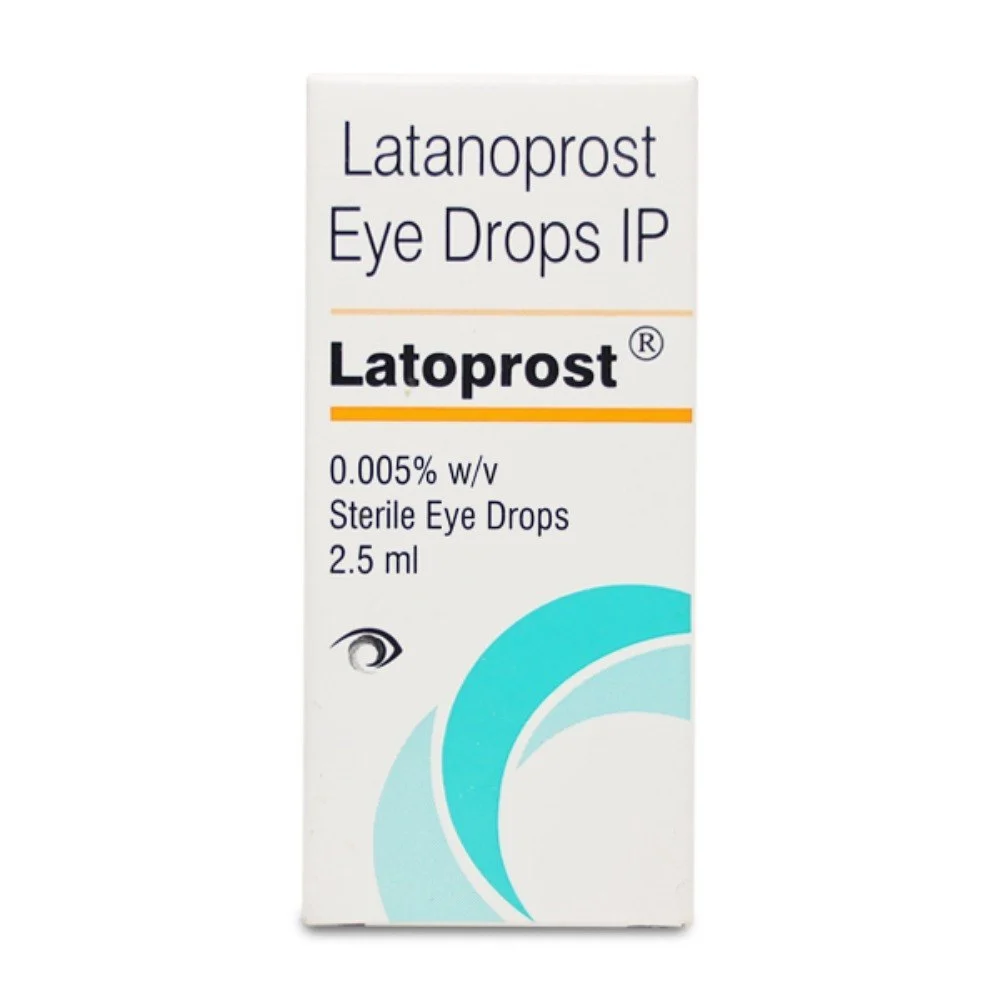
Latoprost Eye Drop (latanoprost)
Price range: $44.00 through $108.00
| Active Ingredient: | latanoprost |
|---|---|
| Indication: | Glaucoma, Ocular hypertension |
| Manufacturer: | Sun Pharmaceutical Industries Ltd |
| Packaging: | 2.5 ml in 1 bottle |
| Delivery Time: | 10 to 15 days |
Latoprost Eye Drops – Uses, Dosage, Side Effects & Buying Guide
Latoprost Eye Drops contain latanoprost, a clinically proven prostaglandin analogue used to lower intraocular pressure in patients with open-angle glaucoma and ocular hypertension.
What Are Latoprost Eye Drops?
Latoprost Eye Drops are a sterile ophthalmic solution containing latanoprost 0.005% as the active ingredient. Latanoprost belongs to the pharmacological class known as prostaglandin F2α analogues, a well-established group of medications used in ophthalmology to manage elevated eye pressure.
These drops are prescribed primarily for adult patients and are formulated to be instilled once daily into the affected eye or eyes. They are available as a preservative-containing solution and are used under the guidance of a qualified eye care specialist or ophthalmologist.
What Are Latoprost Eye Drops Used For?
Latoprost Eye Drops are indicated for the following ophthalmic conditions:
- Open-angle glaucoma – the most common form of glaucoma, where raised intraocular pressure (IOP) can silently damage the optic nerve
- Ocular hypertension – elevated pressure inside the eye without any visible nerve damage, often a precursor to glaucoma
- Normal-tension glaucoma – used off-label in some cases where IOP reduction is still beneficial despite normal baseline pressure readings
These drops are not intended for treating dry eye, eye infections, allergic conjunctivitis, or redness caused by irritation. Always confirm the correct diagnosis with your eye doctor before starting this medication.
How Do Latoprost Eye Drops Work?
Latanoprost works by mimicking a naturally occurring prostaglandin in the body. When applied to the eye, it increases the outflow of aqueous humour — the fluid that continuously circulates inside the eye — through a pathway called the uveoscleral route.
By improving drainage of this fluid, latanoprost effectively reduces intraocular pressure (IOP), helping to protect the optic nerve from pressure-related damage. This mechanism is distinct from beta-blocker eye drops, making it a suitable alternative or add-on therapy for patients who cannot use beta-blockers.
The pressure-lowering effect typically begins within 3–4 hours of the first dose and reaches its maximum effect after approximately 8–12 hours.
Key Benefits of Latoprost Eye Drops
- Clinically proven to reduce intraocular pressure by up to 25–35% from baseline
- Convenient once-daily dosing improves patient adherence to treatment
- Well-tolerated in most adults with a long-standing safety profile
- May be used alongside other IOP-lowering agents (under doctor supervision)
- Does not affect heart rate or blood pressure, making it suitable for patients with respiratory or cardiac conditions where beta-blockers are contraindicated
- Supports long-term optic nerve protection when used consistently
Trusted Health Guides:- Eye Drops: Complete Guide for Dry Eyes, Redness, Allergies & Infections.
How to Use Latoprost Eye Drops Properly
- Wash your hands thoroughly with soap and water before handling the bottle.
- Tilt your head back gently and pull down your lower eyelid to create a small pocket.
- Hold the bottle upside down and instill one drop into the lower conjunctival sac. Avoid touching the dropper tip to your eye or any surface.
- Close your eyes gently. Press your finger lightly against the inner corner of your eye (nasolacrimal occlusion) for 1–2 minutes to reduce systemic absorption.
- Blot any excess liquid from around the eye with a clean tissue.
- If using other eye drops, wait at least 5 minutes before applying the next medication.
- Replace the cap securely after each use.
Recommended Dosage
The standard recommended dosage for Latoprost Eye Drops in adults is as follows:
Standard Dosage:
One drop (approx. 1.5 mcg latanoprost) into the affected eye(s) once daily, in the evening. Evening dosing is more effective than morning administration for IOP reduction.
Do not use more than once daily. Increasing the frequency does not improve effectiveness and may actually reduce the IOP-lowering effect. Dosage in paediatric patients has not been adequately established and should only be used under specialist guidance.
Always follow the dosage instructions given by your ophthalmologist or prescribing physician. Do not self-adjust the dose without medical advice.
Possible Side Effects
Like all medications, Latoprost Eye Drops may cause side effects in some patients. Not everyone experiences them, and many side effects are mild and transient.
Common Side Effects
- Increased brown pigmentation of the iris
- Darkening/lengthening of eyelashes
- Mild eye irritation or stinging
- Conjunctival hyperaemia (redness)
- Blurred vision (transient)
- Foreign body sensation
Less Common / Rare
- Macular oedema (in aphakic patients)
- Uveitis or iritis
- Periorbital skin darkening
- Upper respiratory tract infection
- Muscle or joint pain
- Chest pain (seek immediate care)
If you notice sudden vision changes, severe eye pain, or any unusual reaction, discontinue use and contact your doctor or seek urgent ophthalmic care.
Safety Information & Warnings
Latoprost should not be used during pregnancy as it may have uterotonic properties. There is insufficient evidence regarding safety during breastfeeding. Consult your doctor before using this medication if you are pregnant, planning to conceive, or breastfeeding.
Remove contact lenses before instilling the drops. Wait at least 15 minutes before reinserting them. The preservative benzalkonium chloride present in Latoprost Eye Drops can be absorbed by soft contact lenses and may cause eye irritation.
Temporary blurring of vision may occur after instillation. Avoid driving or operating heavy machinery until your vision has fully cleared.
Long-term use may permanently increase brown pigmentation of the iris, particularly in patients with mixed-coloured irises. This change is irreversible. Inform your doctor if you notice any colour change in your eye.
Who Should Avoid This Medication?
Latoprost Eye Drops are contraindicated in certain individuals. You should not use this medication if you:
- Are allergic to latanoprost, benzalkonium chloride, or any other ingredient in the formulation
- Are you pregnant or planning a pregnancy (use only if clearly indicated by a specialist)
- Have active intraocular inflammation (uveitis) or a history of herpetic keratitis
- Have aphakia (absence of the eye’s natural lens) or a torn posterior lens capsule — higher risk of macular oedema
- Are a child or adolescent (safety and efficacy not fully established in paediatric populations)
Use with caution if you have a history of asthma, although systemic absorption from eye drops is minimal. Always provide your full medical history to your prescribing doctor.
Drug Interactions
While systemic absorption of topically applied eye drops is low, some interactions are clinically relevant:
- Other prostaglandin analogues (e.g., bimatoprost, travoprost) – concurrent use is generally not recommended as it may paradoxically reduce IOP-lowering effectiveness
- Beta-blocker eye drops (e.g., timolol) – commonly combined but should only be used together under an ophthalmologist’s supervision
- Carbonic anhydrase inhibitors (e.g., dorzolamide) – may be used in combination; monitor for additive IOP-lowering effects
- NSAID eye drops – may potentially reduce the efficacy of latanoprost; discuss concurrent use with your doctor
Always inform your ophthalmologist and pharmacist about all medications — including over-the-counter eye drops, supplements, and systemic medicines — that you are currently taking.
Storage Instructions
- Store unopened bottles in a refrigerator at 2°C to 8°C (36°F to 46°F)
- Once opened, the bottle may be stored at room temperature (below 25°C / 77°F) for up to 4 weeks
- Keep away from direct sunlight, heat, and moisture
- Do not freeze the solution
- Keep out of reach of children
- Do not use after the expiry date printed on the label or carton
- Discard the bottle 28 days after first opening, even if the solution remains
Why Buy Latoprost From Eyedrops4U?
Eyedrops4U is a dedicated online pharmacy specialising in ophthalmic products. Here is why thousands of patients trust us for their eye care medications:
Authentic Products
All medications are sourced from licensed manufacturers and verified suppliers.
Prescription Verified
We require valid prescriptions for all Rx-only products for your safety.
Discreet Delivery
Fast, temperature-appropriate packaging delivered directly to your door.
Expert Support
Our qualified pharmacists are available for product and dosage queries.
Frequently Asked Questions (FAQ)?
Can I use Latoprost Eye Drops if I wear contact lenses?
Yes, but you must remove your contact lenses before instilling the drops and wait at least 15 minutes before reinserting them. The preservative in Latoprost (benzalkonium chloride) can be absorbed by soft lenses and may cause irritation to the eye.
How long does it take for Latoprost Eye Drops to lower eye pressure?
Latoprost typically begins reducing intraocular pressure within 3 to 4 hours of the first application. The maximum IOP-lowering effect is usually observed after 8 to 12 hours. Your ophthalmologist will monitor your pressure readings regularly to assess how well the treatment is working for you.
Why does my eye colour seem to be changing after using Latoprost?
Latanoprost can increase the production of melanin in the iris, which may gradually darken the colour of the eye, particularly in eyes that have mixed colouring (e.g., hazel or blue-brown). This effect is permanent and more pronounced with long-term use. It is a known cosmetic side effect that does not cause any harm to vision. Report the change to your doctor at your next appointment.
What should I do if I miss a dose of Latoprost Eye Drops?
If you miss your evening dose, skip it and resume your regular dosing schedule the following evening. Do not administer two doses in the same evening to make up for the missed one, as this will not improve effectiveness and may increase the risk of side effects.
Is Latoprost safe for long-term use in glaucoma?
Latanoprost has an extensive clinical record and is widely regarded as safe for long-term use when prescribed and monitored by an ophthalmologist. Regular follow-up appointments are important to assess IOP levels, optic nerve health, and any changes in eye appearance or vision over time.
Medical Disclaimer:-
Related Products:-
Additional information
| unit | 2 Eye Drop, 4 Eye Drop, 6 Eye Drop |
|---|


Reviews
There are no reviews yet.